Thursday, July 23, 2020

Mythical Greece with LotFP


It's hard to beat the Oddysey and Illiad when it comes to poetic carnage, and it's hard to beat Lamentations of the Flame Princess when it comes to DnD. So why not both?


Herewith a few house rules to play LotFP in Mythical Ancient Greece.

- Spears do 1d8, Javelins do 1d6.
- Reskin all other weapons and armor to fit the setting. Art of the period is really helpful in this regard, and it is all over google.
- If the characters are in the army, everybody gets a spear, javelin, shield, helmet (+1 AC) and sidearm (most likely a short sword) by default. See below for other armor.


Demihumans are ok, but they are basically human in appearance and they are reskinned as demigods:

- Elf: one Olympian parent
- Halfling: child of a dryad and a human father
- Dwarf: child of Hephaestos and a human mother.

A "Dwarf" can choose to train in Tinkering instead of Architecture and takes half damage (rounded down) from non-magical heat. Extra style points if you have some kind of physical deformity.


The default body armor is a breastplate (AC 14, counts as an oversized item).

- If you are playing a Human or "Halfling", you have a 1 in 10 chance of owning a breastplate.
- If playing an "Elf", the chances are 3 in 10.
- If playing a "Dwarf", the chances are 8 in 10.


Choose a patron deity (if "Demihuman", this will be your divine parent), an appropriate name, epithet and parentage (I encourage stealing liberally from Homer and his contemporaries) and you are good to go. Sing, flame-haired muse, the miseries of your player characters!


I've put together a small module based on the Illiad that I've used to playtest this hack to many deaths, shits and giggles. I may publish it at some point so it shall remain hush-hush for now, but in the meantime feel free to use these house rules for your own homebrew, your shameless thieving of the Greeks (what are they gonna do, rise from their graves and sue you?), _____ of the Unknown, Bad Myrmidon, you name it.

(If running a multi-session game, you might want to tie XP to Fame in addition to treasure.)


Now go forth and referee until they all fall to the ground, their armor clattering!

Don't Sleep! There are Snakes and The Thulean Hack playtests to date


These are my systems. There are many like them, but these ones are mine.


Last year I wrote two and a half systems. This post is about the two that I wrote all by my lonesome.


Don't Sleep! There are Snakes is a one-page system. I wrote it in under two hours on an ennui-filled night and published it on a fresh drivethrurpg publisher account the next day. It is based on a single D100 resolution mechanic (originally a Tim "Samwise Seven" Harper idea).

The basic concepts of the system are simplicity, player skill (roleplay over character sheet) and a single physical attribute that doubles as hitpoints.

The system is available on Drivethrurpg as Pay-What-You-Want. I had a lot of fun playtesting it a couple months ago using a pulp 1930s adventure of my own design titled The Golden Lion below Sacsahuamán. I plan to self-publish that adventure in a form easily used with either this system or your Old School game of choice, so the recording of the session remains private for now. Don't Sleep! There are Snakes made for quick play, holding up well to the stress-test in my opinion.


Any similarity to the professor's exploits is "purely" "coincidental".


The Thulean Hack was written on another restless evening and is based on the skeleton of The Black Hack. It is my attempt at taking some ideas from Myfarog 2.6 and reimagining them in the spirit of the old school style of play.

The basic points differentiating this system from Black Hack are:

- Constitution as Hit Points, which makes first-level PCs more beefy but severely curtails level creep
- Differentiating the playable classes even more, including making the Warrior much better at combat than every other class, and strongly tying the classes into the setting
- Willpower replaces Wisdom, the morale mechanic being Willpower-based and affecting PCs as well as NPCs, possibly severely
- Shields make you harder to hit
- A freeform magic system encouraging player improvisation and tied to burning Intelligence.

The system has been playtested twice so far:


The first game on that list was based on my version of the Myfarog 3.0 setting. Myfarog 3.0 is rules-wise practically identical to 2.7, itself an errata version of 2.6. The setting, originally based on European barbarian antiquity, has however been turned on its head by an apocalyptic event laying waste to all major civilized settlements. While this inversion can be summed up in a blog post and hardly justifies publishing a new edition of the game, I found its post-apocalyptic fantasy premise very intriguing. I combined it with a creature from Dolomite folklore, the Anguana, and ran with it.


The second playtest was ran by my friend Ethan and was based on Native American myth from the upper Midwest.


All in all The Thulean Hack played pretty painless. This proves, at the very least, that Black Hack is hard to fuck up.


If you play these systems yourself, let me know how it went!

Saturday, July 18, 2020

Dark Sun with LotFP


A common question I hear asked about Lamentations of the Flame Princess is if it is easy to use with other settings. To which I answer with a resounding YES.


Dark Sun is my favorite TSR DnD setting, and it is naturally a good marriage with LotFP, with its unforgiving approach to lethality and its openness to the possibilites and dangers of Weird Magical Horror.

In the last couple years I ran a few sessions in the setting. Out of those games, and inspiration from Adventures in Parn and the original 2e box set, and in collaboration with Marquis Hartis, I put together the following document. If you use it, let me know how your Lamentations through Athas went!


Friday, July 17, 2020

Gondor calls for aid


Lamentations of the Flame Princess, DnD-adjacent indie publisher extraordinaire, is in serious financial trouble at the moment. Below is what you -yes, you- can do about it.


Due to a confluence of unfortunate factors, most of them outside of James Raggi's control, LotFP finds itself in some serious debt, to the tune of several tens of thousand euro. Among these unfortunate circumstances are:

- A hike in Finnish postal service prices
- Canceled projects and canceled reprints due to fallout from the Zak S controversy, and
- The temporary closing of the US webstore (now reopened) among other pandemic-related distribution hurdles and canceled conventions.

All of these things made 2019 and the first half of 2020 a very bad stretch for LotFP sales, which in turn made it very difficult to repay the company's business loans.


In a gamble for the future of the company, Raggi has put out four new books:

The Deck of Weird Things, a campaign supplement (limited edition)
Fermentvm Nigrvm Dei Sepulti (Black yeast of god's grave), an adventure
Big Puppet, another adventure
Adventure Anthology Blood, a bible-sized adventure compendium comprising several out-of-print LotFP books (The Grinding Gear, Hammers of the God, Weird New World, No Dignity in Death: The Three Brides, and People of Pembrooktonshire) with all-new layout and 100% new art by Kelvin Green.

I bought all four last Monday on release day. Since the PDF versions become available as soon as the order is completed, I was able to peruse all four books, especially The Deck of Weird Things, which I incorporated into my weekly game last Tuesday.

Every one of these books has my ardent recommendation and I consider them money well spent. I will write up a proper review of Deck of Weird Things in the near future.

To get more details about the books, their pricing, and a more thorough account of the financial situation, I encourage you to go here and get it from the horse's mouth.

(There's also new T-shirts)


Some important considerations if you want to take the plunge and help an indie brother out:

- If you want to support the company financially, buying from the official webstores is much better than buying from Amazon or other venues.
Fermentvm, Big Puppet and Blood are available on both the US and EU stores, but Deck and the fancy slipcase for the Blood, Fire and Death Adventure Anthologies are only available from the EU store. However, if you get Deck and use the promo code WEIRD (case-sensitive) at checkout, the shipping on the entire order is free. This is a great opportunity to get you some stuff from the EU store without having to pay those pesky Finnish post prices!
- Some books at the EU store are very low in stock (Broodmother Skyfortress, Isle of the Unknown) and some are limited editions (Midvinter) or will not be reprinted (Blood in the Chocolate, Vornheim, Frostbitten and Mutilated). That, coupled with the fact that the near future is not likely to see reprints of any book (since new product sells better and faster than reprints), makes this a very good time to feed your Lamentations collection.
- Log into the store and add your shipping address to your account to get the correct price displayed. By default, prices at the EU store include VAT, but if you are outside Europe the price will not include that tax.
- If Finland will not ship to your country at the moment because of Covid, there is a workaround. See the official LotFP Facebook group for help.


In short, if you want to see Lamentations of the Flame Princess continue to put out outstanding products, go buy some of these outstanding books right now!


Sunday, March 22, 2020

FFG L5R custom peasant school: Common Trickster


Common Trickster [Courtier, Shinobi]

The "school of the caterpillar" is one based on a plain truth of Rokugani life: nobody fears the meekest. This is not because they think bonge (peasants) and burakumin (non-people) honorable, but because they think them harmless. They are wrong. Through disguise and misdirection, Tricksters can tilt the most disadvantageous playing field.

Tricksters generally hail from non-samurai classes. The least power they project, the more likely their schemes can go unnoticed until it is too late. It is then no surprise that many Tricksters are burakumin or even choose to present as such.

Ring increases: +1 Void
+1 Air or +1 Water

Starting skills (pick five): Sentiment, Theology, Courtesy, Games, Performance, Commerce, Labor, Skulduggery

Honor: 20

Techniques available: Ninjutsu, Rituals, Shuji

Starting techniques:
Shuji (choose three): Look out!, Flowering deceptions, Fluent bargaining, All in jest, Sensational distraction, Shallow waters, Whispers of court

Ninjutsu: Skulk

School ability: Rope to hang oneself: When performing a check to influence a character of higher status, the Trickster may change a number of kept dice equal to his school rank to opportunity results or suffer strife up to his school rank to add an equal amount of bonus successes.
Additionally, when succeeding at a check to influence a character of any status, the Trickster may regain 1 void point or reduce two strife or an amount of strife equal to the strife gained by the target character as a result of the check.

Starting outfit: common or traveling clothes, profession kit or thievery kit, knife, sling, up to two mundane weapons of any rarity, up to two mundane personal effects of any rarity, trinket

School curriculum


Rank 1
Trade skills
Martial skills
Design
Medicine
Command
Rank 1 Shuji
Goading taunt (Shuji)

Rank 2
Scholar skills
Social skills
Fitness
Tactics
Rank 1-2 Kata
Rank 1-3 Shuji
Swirling viper style (Ranged Kata)

Rank 3
Artisan skills
Culture
Performance
Commerce
Skulduggery
Silencing stroke (Ninjutsu)
Pillar of calm (Shuji)

Rank 4
Meditation
Government
Rank 1-3 Kata
Rank 1-4 Shuji
Veiled menace style (Kata)
Bend with the storm (Shuji)
Watch my back (Shuji)

Rank 5
Scholar skills
Social skills
Aesthetics
Commerce
Rank 1-5 Shuji
Roar of encouragement (Shuji)
Laughing fox style (Kata)

Mastery ability: Flight of the caterpillar
The Trickster gains access to any technique type as long as they can personally and frequently have downtime interactions with a character who they know to have access to said technique type.
Once per game session, when making a check with a Social or Trade skill, the Trickster may reroll all of their dice. If they do not succeed, they gain 1 void point.


This post presupposes you have the core rulebook and Path of Waves. Whenever I reference Path of Waves I use italics. I absolutely recommend also checking out the player options included in Courts of Stone for use with this school as it includes a lot of interesting new techniques, particularly Shuji and Ninjutsu.

Saturday, January 25, 2020

New Spring

Herein some GM thoughts for the coming semester.

System fatigue begins to set in for one of my regular games I run, and as such more variety is needed. I will be running a pulpy, tomb-scavenging game for playtesting Don't Sleep! There are Snakes, and a gritty low fantasy game for playtesting The Thulean Hack.


Also in the pipeline for the short term are the conclusion to a short Empire of the Petal Throne adventure, and on the FFG L5R front running a homebrew oneshot and wrapping up Wedding at Kyotei Castle.


Here's to wishing this high octane cocktail of OSR, Petal Throne, L5R and homebrew lulls the Restless GM Syndrome and chases away the American Academia Blues.

In the long term, hopefully sooner than later, I want to run:

A LotFP campaign starting with Adventure Number 10 and stringing together assorted modules and stuff pulled out of the old wizard hat,


and a Blueholme campaign giving my own gonzo twist to traditional fantasy. Kitchen sink, humor belongs in TTRPGs, trying to use all my books, the works. Hey, I never ran straight up fantasy before!

Monday, December 9, 2019

A World of Our Imagination

The essay below was written as the final paper of a composition class at SFSU.


From Genesis to Revelation
A very brief history of Dungeons & Dragons


In 1974 Gary Gygax and Dave Arneson took Chainmail, a glorified boardgame for adult history aficionados and Tolkien fanatics, and turned it into Dungeons & Dragons (D&D), a game of storytelling and improvisation for imaginative people of all ages. This was a game like no other, in that it captured the free flowing spirit of campfire stories and theatrical improvisation, the rules being simply a tool to help players step into a land of shared make-believe. This was a world of pure imagination.


Original D&D (left, 1974) and Holmes Basic D&D (right, 1977)


This first edition of the game, nicknamed "Original" D&D, was followed by the "Holmes Basic" edition in 1977 and then by the "Moldvay Basic" edition in 1980. This latter edition made the game a definite success.


The Moldvay Basic Rulebook (1980)


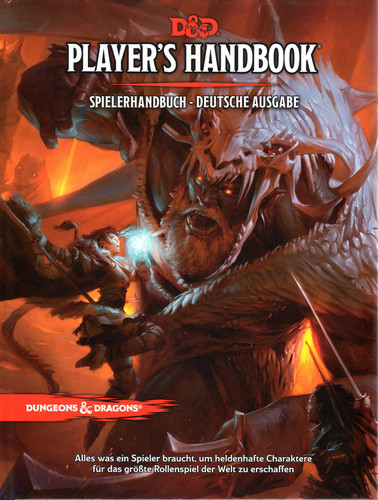
In 2014, Dungeons & Dragons jumped into the mainstream with the launch of the Fifth Edition of the game, a huge commercial success. The print and page design quality of the books were unparalleled in the game's history, and the quality of the cover was no exception.


Fifth Edition Player's Handbook (2014)


Visual Aids for the Imagination

Dungeons and Dragons is, at heart, a game of make-believe in which players describe what is happening with words, and the players' imaginations complete the picture. I aim to compare the art of the Moldvay Basic edition cover from 1980, to the art of the 2014 edition cover. I argue that the old, simpler art style did more to stimulate the imagination than the modern, more visually dazzling style.


There is no artwork I know can compete with your imagination


"How do you Win this Game?"
How D&D works at the table

First of all, let us take a look at how a game of D&D actually works in practice. There is a "Dungeon Master" --a sort of Referee-- and a number of other Players --each playing a Character as in a play--, ranging from one to however many can fit around the living room table. The purpose of the game is to create a story. The Dungeon Master presents a situation to the players (e.g. there is a damsel in distress, or a treacherous schemer conspiring against the realm, or a bandit in the forest with a heart of gold), and the players attempt --in Character-- to unravel it. This is all done by talking about it and acting it out, and everybody at the table imagines what is happening as it is being told. Whenever a Character attempts to do something to advance the story, something momentous, where it could change the outcome if it fails or it succeeds, there is a dice roll to determine what happened. Then, the players at the table describe or act out the details of what has happened, and the story continues on.

D&D, then, is not a game with winners and losers, but something more like theatrical improvisation or telling a story around a campfire. There are rules for when a Character attempts something important or difficult, but there is also an element of total randomness. Nobody knows how the story is going to end until you come to a good stopping point (the heroes have triumphed, died in the attempt, fled in disgrace, or decided instead to join forces with the charming bandit of Sherwood Forest), and you collectively declare the story to be over -- at least for that weekend. The only way to lose at D&D, one could argue, is not to have fun. And the best way to have fun at it is to use your imagination.


Blank Pages vs Coloring Books
How style hints at the substance of play


Now that we're all on the same page, let's get back to those two covers. Though one should not judge a book by its cover, it still happens, and so companies seek to make covers attractive. This is especially important when one takes into account that the intended audience of these books spans an age range that starts at elementary school and continues into retirement. D&D lives and dies thanks to its Players and Dungeon Masters, and it has always been in the interests of the company to keep the players coming back for more. Because it is a game that relies on the imagination, it is a game that can potentially be replayed for the entirety of a person's life, with no two games being exactly the same.

The purpose of these covers, then, is to spark the imagination, because the books contain the rules, but the game itself is born in the minds of the players. The rules come complete in order to cover most possible situations, but the game is not complete until it is played.


Moldvay Basic (1980) and 5th Edition (2014)

On the surface, the 5th Edition cover is dazzling. There is good use of color and shadow and the composition leads the eyes to the center of the scene, where the single heroine faces impossible odds against the giant, whose body takes up almost the entire frame. There is another character on the bottom right, but he appears as a mere spectator to the heroine's clash, so much so that he is easily missed. The style is reminiscent of modern computer games and CGI-heavy movies.

The Moldvay Basic cover has not aged that well, as it is much more rudimentary by comparison, with little use of shadow or perspective, as well as less realistic lighting and color. The scene is framed as if viewed through a small window. A party of two adventurers face down a dragon together. The characters and their enemy almost appear to be on the same plane. The style brings to mind fantasy books for children or younger teenagers. It almost seems like the finest details and textures of the figures have been left deliberately unfinished.

These differences are related to the different contexts that these books were published in, but even taking this into consideration, I argue that the 5th Edition cover misses the original intent of the game. Let us first address those different conditions, however.


The Moldvay Basic cover only had other books, and two-dimensional animated movies, to compete with. There was, however, a clear attempt to use art to hook the potential gamer, as can be seen by the fact that the art encompasses about half the page, as opposed to what was happening on the cover of Original D&D (left).


Right: World of Warcraft, Blizzard Entertainment's most successful videogame 


The 5th Edition cover was competing with modern computer games, movies chock full of CGI nearly indistinguishable from reality, and it was no longer the only game in town. By 2014, the concept of Tabletop Roleplaying Games had taken off, and D&D actually had competitors.


Yet, it is the style of the 1980 Moldvay Basic cover that better captures the spirit of the game. D&D is at its core a game that aims to transcend any art displayed in its rulebooks, since no amount of beautiful shading can compete with the imagination. As such, the more rudimentary style of the 1980 art illustrated that concept right from the cover: this is an unfinished template for the most incredible thing you, the readers, can imagine around the table. It is up to you to imagine the shining scales on the dragon and their reflection on the tip of the spear. You will make it come alive.

The 5th Edition cover, by comparison, presents a practically finished product. The heroine faces the giant in deadly combat and something momentous is about to happen. What could it be? Wait-- the text at the bottom reads "Everything a player needs to create heroic characters for the world's greatest roleplaying game." The fact that she is meant to win is a foregone conclusion. Instead of telling the reader this is a game that lets anything happen, it is telling us this is a game where you can do things like this. Insofar as this runs counter to the core of the game, I argue that this cover is actually less effective.

Moving forward, I will address two other points that further exemplify this argument: D&D as a social game, and D&D as a game with infinite replayability.


A Gaming Table to Rule them All
D&D: a social game


A Dungeon Master and her Players getting deeply into character


I was first introduced to D&D by my brother as a young teenager, but after a few games I put the hobby on the shelf until 2017. Since then, I have delved deeper, participating in dozens of games with neighbors, fellow San Franciscans, and through the magic of online conference calls, people from all over the globe. D&D is a game of constant interaction, both with the Dungeon Master and one's fellow Players. At its heart, and from the very beginning, it has been a group game.

This is, in my view, an incredibly positive aspect of the game, in that it promotes socializing and cooperating. It is by cooperation that the party of Characters can make off with the princess, the treasure or both, and it is also by cooperation that a gaming table creates a memorable experience for everyone to treasure forever. Dungeons and Dragons is an inclusive game, a factor that no doubt contributes to the fact that people of all sexes, sexual orientations, gender identities and different walks of life are drawn to the game. D&D has even been used in prisons to improve inmate morale, promote socialization and fight segregation, including within the California prison system.


Going back to the aforementioned covers, 5th Edition presents a lone heroine in mid-jump attacking the giant, while Moldvay Basic shows a group of two adventurers battling the dragon, their feet presumably square on the ground, shield held up and even a torch to battle the darkness. Tell me, reader, which of these covers most looks like an introduction to a social game portraying the journey from zero to hero, instead of the final result? You guessed it -- they had this stuff figured out in 1980.


A Neverending Story
The Old School Renaissance: how Old School D&D inspires creators to this day

One of the main reasons that Dungeons and Dragons has had so much appeal is that the game can be played an infinite number of times and it will never play exactly the same. This depends, however, on the Dungeon Master and Players' ability to use their imagination to introduce twists into the old tropes. This is an area in which the D&D player community has really shined, by writing, compiling and publishing swaths of original third-party content for the game. Some of this is featured in blog form --see the blogroll to the right of this post-- and some of it in books like the one at the bottom below, which --surprise, surprise-- pays homage to the art of an early edition.


Holmes Basic (1977) and Blueholme (2017)


And so it came to pass that...
Until we meet again, adventurer

A game that empowers its players as much as D&D would likely fail to impress a marketing department were it not for the numbers that prove it can be a success. After all, when a table creates its own world, its own content, and its own spin on the fantasy tropes, Wizards of the Coast, the current owner of the D&D brand, does not make a single extra dollar. But once a mind has tasted the fruit of its own imagination, it will keep coming back, and it will gladly pay for a book that serves as an inspiring springboard to another story not yet written, to a world not yet created, a world that will only get its finishing touches at the table -- at least until the following session. Wizards of the Coast has a golden dragon on its hands, and if they only look to past editions, that golden dragon will keep laying golden eggs.


About the author


Ignacio Fernández Ivern is a student of Linguistics from the University of Buenos Aires currently continuing his studies at San Francisco State University with the end goal of an MA in Linguistics. He has made a living tutoring, teaching, interpreting and translating since 2008. He is the co-author of three Tabletop Role Playing Game books of future publication. His free time is spent playing Tabletop RPGs with his friends, or smiling at his very patient wife.